
monesiglio
Sanctuary of Santa Maria dell’Acqua Dolce
In Monesiglio, you can admire a rich collection of medieval paintings. The Sanctuary of Santa Maria dell'Acqua Dolce houses a notable example of Romanesque painting in the apse, with traces of 13th-century frescoes also visible in the first bay. The castle's private chapel, however, contains Renaissance frescoes by Antonino Occelli, although compromised, while the Chapel of San Martino preserves a typical late Gothic pictorial model depicting Christ in a mandorla (almond shape).
Between Mombarcaro and Prunetto, on the right bank of the Bormida River, lies the town of Monesiglio, first mentioned around the mid-10th century as a “court” in the imperial diploma of 967, which granted vast estates to Aleramo. Between the late 10th and early 11th centuries, Monesiglio became part of the possessions of the bishops of Savona, while at the end of the following century, the Benedictine monastery of San Quintino di Spigno Monferrato also mentioned rights to these lands. Subsequently, it became a fiefdom of the del Carretto family (receiving imperial investiture in 1355), who shared lordship with the Caldera family, who over time acquired an increasingly significant portion of the land, eventually becoming the Saluzzo family in the modern era.
Sanctuary of Santa Maria dell’Acqua Dolce
Built on the banks of the Bormida River, the Sanctuary of Santa Maria dell’Acqua Dolce (Saint Mary of Sweet Water), known locally as San Biagio, offers a significant example of Romanesque architecture in its exterior. Although not clearly recognizable as a parish church in Ottonian documents, it appears as a monastery in 1325 in a list of religious properties of the Diocese of Alba. Over the centuries, it has undergone various interventions, especially in the Baroque period, with major restorations begun by Bishop Marino in 1573, who ordered the roof reconstruction at the expense of the local lord, Giovanni Antonio Caldera.
The building, dating back to the 11th century, is characterized by the presence of three interlocking semicircular apses, embellished with a series of elegant hanging arches: while the southern apse is inexplicably plastered, the central apse, which is taller, is distinguished by an additional band of arches at the top. The gabled façade, although restored over time, still retains its typical hanging arch decorations.
Various modern restorations have substantially preserved the original medieval structure of the apse, whose pictorial decoration is dominated by the figure of Christ blessing. In the middle register, there are several representations of the Apostles, interspersed with three single-lancet windows. The lower section likely featured a series of figures of saints within an arch or narrative episodes: of this sequence, the upper detail of the Madonna and Child is still partially visible.
This remarkable pictorial cycle, dating back to around the 13th century, is admired for its vibrant use of color, a certain rigid two-dimensional spatiality, also conveyed by the figures depicted with slow, schematic movements, and some traces of typical plant and vegetative decorations.
In the upper part of the last bay, the one closest to the apse, traces of 13th-century pictorial decorations are surprisingly re-emerging due to the accidental detachment of later, overlapping paintings.
At the entrance to the Sanctuary, on the right wall you can see a pictorial piece from another era, dating back to the second half of the fifteenth century: it is a votive panel depicting the Madonna and Child surrounded by Saint John the Baptist and Saint Anthony the Abbot in their traditional robes.
Private chapel of the Castle
At the top of the village, the current private chapel of the Caldera-Saluzzo Castle was originally part of the original church of Sant’Andrea, the first parish church located in the center of the town. Its medieval tower, later incorporated into the complex stratification of the manor, still stands. Documentary sources indicate that the church of Sant’Andrea originally served as a private chapel for the castle of the local lords, as attested by a deed issued by Henry II of Savona in 1221 in the “castri chapel.” However, by the 14th century, it had become the community church. The castle’s transformation into a noble residence dramatically altered the architectural complex, demolishing part of the old parish church, which was rebuilt nearby, and preserving part of the side nave, converting it into a private chapel. Despite its poor state of preservation (especially when the castle was converted into a retirement home), it boasts one of the earliest examples of Renaissance painting in the area.
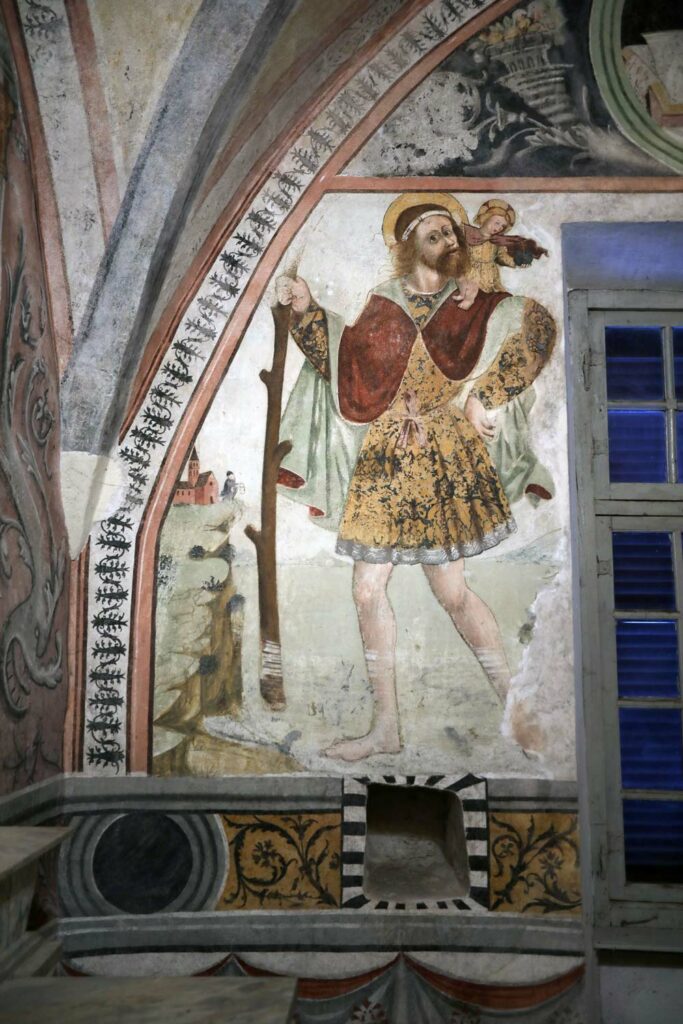
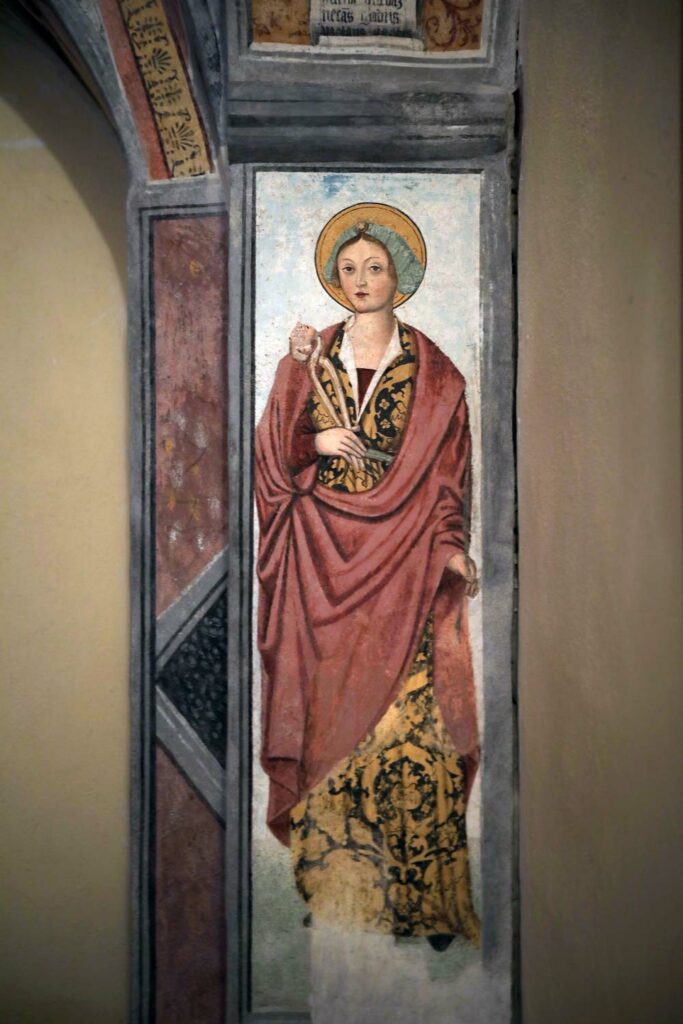
The decorative cycle that admirably adorns the walls of this chapel is attributed to Antonino Occelli da Ceva, whose contribution is attested by a faux marble inscription to the side of the altar. In addition to his signature, this inscription reports the completion date of the work, November 15, 1532, and the names of the patrons (Antoninus Dota and Guillerminus de Ogeris). One of these patrons could be identified as the kneeling figure painted to the sides of the current altar, whose subsequent relocation has damaged the wall decoration. The pictorial cycle also extends to the vault, where the Four Evangelists are depicted, and to the walls, where several saints are depicted, including Christopher, Peter, and Paul, and an unidentified warrior saint, unfortunately compromised by the opening of a modern window. In the entrance arch, a nearly complete depiction of Saint Apollonia, wearing a damask dress and sophisticated hairstyle, precedes six Sibyls, set in medallions and accompanied by explanatory scrolls, facing the figure of King David, depicted half-length with a descriptive scroll and an open book. Completing the ensemble are a classical-style frieze with plant motifs and a light-colored velarium decorated with stencils along the walls.
The medieval chapel of San Martino
Monesiglio offers a rich collection of medieval paintings, from Romanesque examples to the first cycles of fully Renaissance frescoes. On the hill overlooking the town, where the ancient church of Sant’Andrea and the castle once stood, the presence of the chapel of San Martino is mentioned in the records of the Diocese of Alba at the beginning of the 14th century. It is believed that this chapel may have housed a monastery in the early Middle Ages, although a specific attestation identifies it as a chapel only in the 14th century. Inside the chapel’s apse is a depiction of Christ in a mandorla (almond shape), dating back to the mid-15th century. However, due to its inaccessibility to the public, it is not possible to fully assess the work’s state of preservation.